
Securing the AI Stack to Safeguard Democratic Values and Global Leadership
One of the most consequential infrastructure questions of this decade isn’t about roads or pipelines but rather about where the servers powering our growing digital economy will be located. As artificial intelligence (AI) continues to become the primary driver of innovation and the global economy, the geographical location of AI infrastructure is not merely a technical detail, but rather a question of liberty, security, and who writes the rules for the technology that will shape the next century. To ensure that the future of AI reflects the core principles of liberty, freedom, and human dignity, the entire AI stack—from physical hardware and data centers to advanced models and consumer applications—must be made, hosted, and secured here in America.
The AI Stack Explained: From Ground to Cloud
To understand why American sovereignty over AI infrastructure matters, we should define the term “AI stack.” The foundation of the AI stack is the hardware and infrastructure, advanced semiconductor chips and graphics processing units (GPUs) housed in data centers that provide the necessary compute power to run and store all the layers. Stacked on top in ascending order is the data used to train models, the work of designing, training, and fine-tuning the models, the engineering that turns the algorithms and foundational models into deployable products, and finally, the apps and tools consumers actually use, like chatbots, productivity tools, and automation systems.
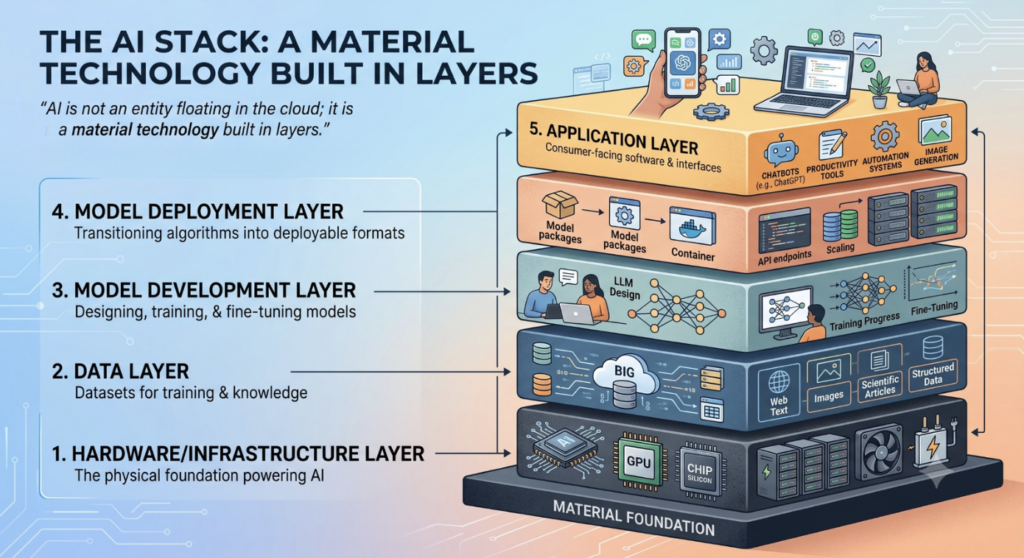
Here’s the part many people miss: these layers are not independent. A compromise at the bottom, such as a tampered chip derails everything built on top of it. Trustworthy AI applications do not exist if sitting on an untrustworthy foundation. That’s why getting the physical layer right, on American soil, under American law, is a core priority.
When a data center operates inside U.S. borders, it operates under the Constitution. That means due process before seizure, real legal protections for data and intellectual property, and courts that answer to law rather than to a party apparatus.
Compare that to the alternative.
In countries like China, the state maintains absolute authority to seize private data, mandate backdoors into software, and misappropriate intellectual property under national security laws. Hosting the AI stack in America is basic risk management to prevent supply chain tampering, data interception, and IP theft by regimes that have shown zero hesitation in pursuing all three.
Instilling American Values into the Digital DNA
The legal frameworks governing where a model is trained set the ethical defaults that are baked into how it behaves.
Build the stack in America, and you build in diverse free expression and resistance to top-down control as defaults. Let the foundational infrastructure migrate to authoritarian jurisdictions instead, and don’t be surprised when AI becomes a tool for surveillance, systemic censorship, and social control rather than empowerment.
If the global standard for AI is set by American infrastructure, the technology will naturally serve the individual, rather than serving the state. The battle for the data center is ultimately a battle for the ethical foundation of the digital age.
The country that leads in AI will set the terms for the rest of the century, economically and strategically. That’s how technology races have always worked. Maintaining American dominance in AI is not just a matter of national pride and promoting democratic values worldwide; it is also a prerequisite for economic competitiveness and national security.
A robust domestic data center buildout means American businesses, researchers, and defense agencies aren’t waiting on anyone else’s permission or infrastructure to access cutting-edge compute. By creating a resilient, self-reliant ecosystem, Americans will not be exposed to supply chain blackmail from adversaries who’d happily use that leverage against us. It means breakthroughs, whether in medicine, agriculture, or national defense, will happen here first.
Sharing the Stack: Building a Global Alliance of the Free
There’s an opportunity in this beyond our own borders. An American-built, American-secured AI stack lets us extend that infrastructure to allies who share our commitment to open societies and the rule of law. Nations without the resources to build their own data center capacity can plug into ours, confident their data isn’t one political order away from confiscation by a hostile state. That’s how you build a durable coalition of free nations in tech. The same is not possible through mandates. The way forward is providing a better, safer option that allies actually want to use. This digital alliance fortifies democratic values worldwide, counters the spread of digital authoritarianism, and ensures that the global tech ecosystem remains free, fair, and open.
The Path Forward for American Innovation
The future of AI cannot be left to chance, nor can it be outsourced to nations that oppose our way of life. To champion human liberty, preserve our economic leadership, and protect our national security on the global stage, we must build, power, and defend the AI stack in America.
Policymakers should prioritize supporting the expansion of domestic data centers, streamlining energy permitting, and fostering a free-market environment that rewards American ingenuity. By securing the physical foundations of tomorrow’s technology, we can ensure that we lead the AI revolution.
And that AI revolution is happening regardless. The only question is whether it’s built on a foundation of American law and American values, or someone else’s.