
Three Key Takeaways:
- Data centers have proven to be good neighbors and economic engines in Ohio
- Data centers are a national priority with strong support at the highest levels
- Disinformation campaigns should not be allowed to block data centers – just as Ohio lawmakers did not allow disinformation to block fracking
NetChoice Testimony to Ohio House of Representatives Select Committee on Data Centers
June 11, 2026
Select Committee on Data Centers
Ohio House of Representatives
Columbus, Ohio
Chair Holmes, Co-Chair Chavez and members of the committee:
NetChoice is a trade association of the world’s leading online businesses. We are leaders in tech policy in the states, in Washington, D.C. and in the courts. We welcome the chance to discuss the massive capital investments and the economic and tax benefits that hyperscale data centers bring to Ohio. I’d like to make just three points today:
- Data centers have proven to be good neighbors and economic engines in Ohio
- Data centers are a national priority with strong support at the highest levels
- Disinformation campaigns should not be allowed to block data centers – just as Ohio lawmakers did not allow disinformation to block fracking
1. Data Centers Have Proven to be Good Neighbors and Economic Engines in Ohio
Data centers of NetChoice members Amazon, xAI, Google, Meta and OpenAI enable Americans to find information, buy and sell, navigate their world and maintain their memories in messages, emails, documents, photos and videos. Moreover, data centers provide cloud storage and processing for America’s businesses, institutions, organizations and government.
Data centers can be located anywhere in the country and serve users everywhere, due to America’s excellent internet connectivity. So data centers locate where they are welcomed by local communities. When you consider the economic benefits of construction projects, high-paying tech jobs and property tax relief, many Ohio communities were able to attract new data centers. The results are impressive. In 2024 alone, data centers delivered big benefits for Ohio communities (PwC, Economic Contributions of Data Centers in the US, 2023-24):
- 24,000 direct jobs in data centers
- 100,000 total employment, including direct, indirect and induced effects
- $8 billion in labor income
- $14 billion in GDP
- $1 billion in tax contributions to state and local governments
Nationally, PPI’s INVESTMENT HEROES 2025 shows Tech/Internet as the top sector for capital investment, driven by investment in data centers and AI-related infrastructure. With data centers and AI, America’s tech industry is investing far more than our energy, telecom, pharma or manufacturing industries (Progressive Policy Institute, Investment Heroes 2025).
2. Data Centers are a National Priority with Strong Support at the Highest Levels
Modern military and intelligence operations increasingly depend on AI for real-time analytics and massive data processing. Domestic data centers are essential to training and deploying AI models for defense applications without exposing that work to foreign intelligence collection.
Much of America’s cloud computing industry relies on infrastructure with global footprints, including nodes in countries with adversarial relationships with the U.S. Building domestic capacity reduces the risk of foreign governments cutting off access or inserting backdoors into critical systems during a geopolitical crisis. Hosting America’s cloud infrastructure in another country is a bad idea.
National security is not just military — it is also economic. Maintaining domestic dominance in data infrastructure helps the U.S. stay ahead of China and other rivals in the AI race, which many defense analysts consider the defining technological competition of the 21st century.
Since the beginning of his present administration, President Trump has championed data centers and AI as national priorities. The consistent message from the White House is: whoever controls the most powerful AI infrastructure controls the future of economic and military power. China is building data centers aggressively. The US cannot afford to slow our data center buildout when our geopolitical rival is moving so fast.
Further, data center construction aligns with President Trump’s broader message of economic nationalism. Large-scale data centers create construction jobs, manufacturing demand (servers, cooling systems, cabling) and permanent operational tech jobs.
President Trump links data center growth to his “energy dominance” agenda — arguing that America’s abundant energy resources (natural gas, coal, nuclear) position it uniquely to power massive data infrastructure that other countries cannot sustain as cheaply or reliably. This White House support for data centers is consistent and supported by multiple Executive Orders:
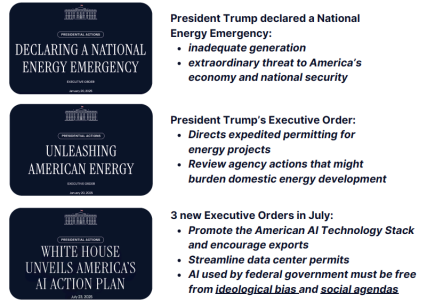
President Trump knows that America must keep winning in technological development—for our national security, data security and future prosperity. We are working with his administration on this critical infrastructure for America’s future.
3. Disinformation Campaigns should not be Allowed to Block Data Centers – just as Ohio Lawmakers did not Allow Disinformation to Block Fracking 20 Years Ago
America’s tech industry is #1 when it comes to investing in American communities and America’s future, while data centers and AI have become a top national priority. And yet, over the last 16 months something has dramatically changed how data centers are described and perceived by Americans.
In county meetings and state legislatures across the country, the narrative about data centers is now dominated by fears over electricity rates, water consumption, land use and noise. But the actual experience in Ohio and elsewhere shows that large data centers are responsible consumers of electricity and water, while complying with all local ordinances for noise, setbacks, etc.
Please visit one of the hyperscale data centers operated in Ohio today by the leading companies who testified here last week. Please ask Ohioans how they feel about living in a community with a large data center – ask neighbors, the local business community, people who work in the data centers, county officials and homeowners who are seeing property tax relief as well as infrastructure improvements.
Before halting data center development, ask who benefits from that? Not American workers or communities looking for investment and tax relief. Not an American economy that needs data centers to drive the next wave of productivity, innovation and growth (Bartlett Cleland, “Stop foreign interests from stealing America’s AI future”, April 27, 2026).
The beneficiaries of data center delay are America’s competitors — nations like China who want to propel their economy with AI and have the rest of the world adopt their AI hardware and software. China’s government has funded groups who oppose data centers and amplify misinformation on social media (“Sen Tom Cotton urges DOJ to probe Chinese bid to ‘kneecap’ American AI”, June 10, 2026). European billionaire climate activists have also supported efforts to stop America from expanding its energy grid to serve data centers (Sam Lyman, Bitcoin Policy Institute, “Foreign Influence in the Campaign against American AI”, May, 2026).
This is not to dismiss concerns and questions raised by genuine Ohio citizens. Those concerns can and should be addressed with evidence and assurances. But disinformation travels faster than facts, and we need help from Ohio leaders and lawmakers to point to experience and protective policies.
That’s what happened 20 years ago when Ohio communities were seeing a surge in oil and gas production via “fracking.” Then, as now, disinformation drove citizen fears of groundwater contamination, toxic chemical injections and earthquakes. Russia’s government supported amplification of those fears in order to slow the growth of American energy production.
Then, in 2004 the Ohio legislature centralized permitting authority for oil and gas under the Department of Natural Resources, preventing municipalities from using local zoning laws, permits and fees to delay or block drilling operations (Ohio House Bill 278, 2004). The streamlined permitting process helped farmers and rural landowners to benefit directly from oil and gas leases. Severance taxes were also funneled back into regional development programs and local regulatory oversight.
That’s a playbook Ohio can run again – this time to address fears and disinformation about data centers, which can benefit Ohio communities and drive America’s future.
Sincerely,
Steve DelBianco
President & CEO
NetChoice (The views of NetChoice expressed here do not necessarily represent the views of all NetChoice members.)