
We focus our testimony on four points:
- Data centers have delivered substantial economic value to Texas communities.
- Data center investment is a priority for national security and economic security.
- Texas has a competitive tax and business climate that attracts data center and AI investment.
- Texas regulated–and allowed–fracking 30 years ago, and the state has reaped remarkable benefits. This is our generation’s chance to place a similar bet on AI and data centers.
NetChoice Testimony for the Texas Senate Committee on Finance Interim Hearing on Data Center Investment and State Fiscal Effects
July 27, 2026
Chair Huffman, Vice Chair Hinojosa and Members of the Committee:
NetChoice is a trade association of the world’s leading online businesses. We lead on tech policy in the states, in Washington, and in the courts. Today, NetChoice members Amazon, Google, OpenAI, X, and Meta operate data centers across Texas. We welcome the opportunity to discuss the capital investment, economic activity, tech jobs, and property tax relief that data centers bring to Texas. We’d like to make four points today:
1. Data centers have delivered substantial economic value to Texas communities, 2. Data center investment is a priority for national security and economic security, 3. Texas has a competitive tax and business climate that attracts data center and AI investment, and 4. Texas regulated–and allowed–fracking 30 years ago, and the state has reaped remarkable benefits. This is our generation’s chance to place a similar bet – on AI and data centers.
Data Centers Have Delivered Substantial Economic Value to Texas Communities
Data centers enable Texans and Texas businesses to find information, buy and sell, and store their photos, documents, and communications, while providing the cloud storage and processing that Texas businesses, hospitals, universities, and government agencies increasingly rely on. Data centers locate where they are welcomed, and many Texas communities have welcomed them. In 2024 alone, Texas’ data center industry contributed $66 billion to state GDP and $4.5 billion in state and local tax revenue, while supporting more than 428,000 jobs statewide, including nearly 104,000 direct jobs (PwC, Economic Contributions of Data Centers in the United States, 2023–2024 (prepared for the Data Center Coalition, May 2026), available at centerofyourdigitalworld.org/2026-impact-study).
Host communities see tangible benefits beyond these figures. A single hyperscale campus can mean well over a billion dollars in construction spending and thousands of skilled-trade jobs, and its assessed value is large enough to meaningfully ease the property tax burden on surrounding homeowners while helping fund local schools, roads, and public safety. Hyperscale data center operators in Texas have also made voluntary investments in water-efficient cooling and renewable energy.
Data Centers are a National Priority with Strong Support at the Highest Levels
Modern military and intelligence operations depend on AI for real-time analytics and massive data processing. Domestic data centers are essential to training and deploying AI models for defense applications without exposing that work to foreign intelligence collection.
Much of America’s cloud computing industry relies on infrastructure with global footprints, including nodes in countries with adversarial relationships with the U.S. Building domestic capacity reduces the risk of foreign governments cutting off access or inserting backdoors into critical systems during a geopolitical crisis. Hosting America’s cloud infrastructure in another country is a bad idea.
National security is not just military — it is also economic. Maintaining domestic dominance in data infrastructure helps the U.S. stay ahead of China and other rivals in the AI race, which most defense analysts consider the defining technological competition of the 21st century.
Since the beginning of his present administration, President Trump has championed data centers and AI as national priorities. The consistent message from the White House is: whoever controls the most powerful AI infrastructure controls the future of economic and military power. China is building energy generation and data centers aggressively. The US cannot afford to slow our data center buildout when our geopolitical rival is moving so fast.
Further, data center construction aligns with President Trump’s broader message of economic nationalism. Large-scale data centers create construction jobs, manufacturing demand (servers, cooling systems, cabling), and permanent operational tech jobs.
President Trump links data center growth to his “energy dominance” agenda — arguing that America’s abundant energy resources (natural gas, coal, nuclear) position it uniquely to power massive data infrastructure that other countries cannot sustain as cheaply or reliably. This White House support for data centers is consistent and supported by multiple Executive Orders:
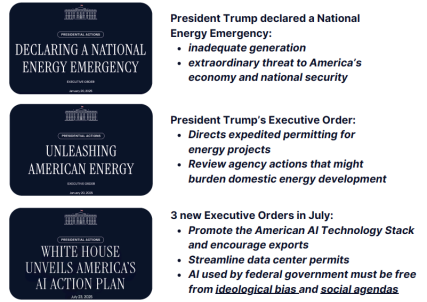
President Trump knows that America must keep winning in technological development—for our national security, data security, and future prosperity. NetChoice is working with his administration on this critical infrastructure for America’s future.
Texas has a Competitive Tax and Business Climate that Attracts Data Center and AI Investment.
Land availability, a skilled workforce, ample power, and a business climate that includes competitive tax treatment have combined to make Texas a top destination for hyperscale data center investment. The sales tax exemption under Tax Code Sections 151.359 and 151.3595 is a significant factor. Rather than singling data centers out, the exemption brings them in line with how Texas has always treated its capital-intensive industries: servers and systems are the production equipment of a data center, in the same way that heavy machinery is production equipment for oil & gas industries, manufacturing, and agriculture.
Section 151.359 simply extends Texas’ existing production-equipment exemption to the equipment that produces digital output. So it is not a “tax incentive” that steers taxpayer dollars to a selected company or project.
This competitive climate matters because data centers can locate anywhere and still serve users everywhere. Thirty-seven states have updated their sales tax law to exempt data center equipment – just like they do for business machinery and equipment purchased in manufacturing and agriculture.
Moreover, no hyperscale data center project has located in a state that imposes sales tax on data center equipment. Texas competes with Virginia, Ohio, Arizona, and Georgia for the same investments, and these states have debated – but maintained – their data center sales tax exemptions. Absent the sales tax exemption, most of this investment would have happened in competing states instead of Texas.
So, when evaluating the Texas exemption’s fiscal effect, the relevant analysis is not how much sales tax Texas is “giving up”. All of the incremental benefits of investment, jobs, and property tax relief have come to Texas because of the sales tax exemption, and these benefits would not have been realized if Texas had not updated its tax code. The correct analysis is that Texas has realized these benefits because it taxes data center equipment the same way it taxes business machinery for energy production, manufacturing, and agriculture.
Texas Regulated–and Allowed– Fracking 30 Years Ago, and the State has Reaped Remarkable Benefits. This is Our Generation’s Chance to Place a Similar Bet – on AI and Data Centers.
Thirty years ago, innovators in oil and gas production developed hydraulic fracturing combined with horizontal drilling in the Barnett Shale formation. Environmental and seismic concerns were raised by some, and Texas lawmakers responded by regulating fracking – not banning it – which was the response of lawmakers in New York, California, Vermont, Washington, and Maryland.
Today, oil & gas production through fracking is a major contributor to the Texas economy, government tax revenue, and to America’s national energy security. Data centers built by American tech companies that are appropriately regulated offer a similar opportunity to drive the Texas economy and beat China in the race to dominate the global AI race.
Let’s answer the challenge in our generation and bet on American investment and innovation – while protecting Texas landowners, ratepayers, and taxpayers.
Conclusion
NetChoice appreciates the committee’s careful, data-driven approach to this interim charge. The evidence shows the sales tax exemption is functioning as intended, attracting investment, jobs, and property tax relief that Texas would otherwise lose to competing states. We stand ready to provide additional data or testimony as the committee’s work continues on legislation for the 2027 session.
Sincerely,
Steve DelBianco
President & CEO
NetChoice (The views of NetChoice expressed here do not necessarily represent the views of all NetChoice members.)